The Brigadier
The IPCRESS FileThe Brigadier is a senior military officer responsible for security at Tokwe Atoll, where his authority is visible both in the island’s elaborate surveillance system and in the questioning of the detained narrator. Addressed by Dalby as Jimmy, he embodies a tension central to his role: confidence in the scale and efficiency of American power, paired with a willingness to test evidence rather than simply accept an accusation. His decisive contribution is to turn the island’s surveillance recordings into a clue that reveals how Dalby evaded its defenses.
Identity and Position
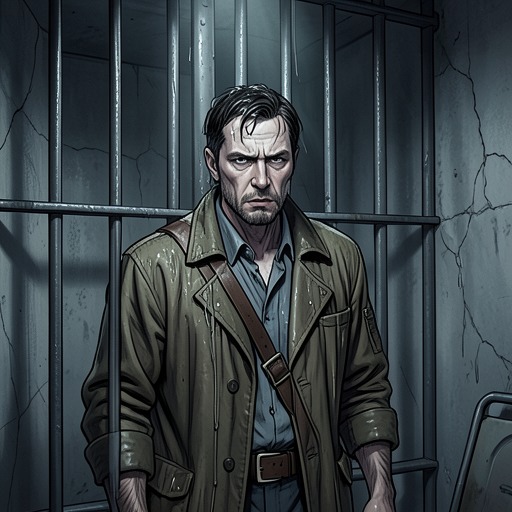
The Brigadier appears among the uniformed officials and personnel on the atoll and is identified by the narrator as the older officer who had spoken with Dalby. He is described as over sixty, broad-boned and athletic, with close-cropped grey hair and fine gold-framed spectacles. Those details give him a recognizable public presence, but his own account of his job is less grand: he is the person sent to check places like Tokwe for weaknesses in their defenses. The metaphor is modest; the authority behind it is not. He can question a suspected security threat, call on medical and psychiatric examiners, and bring the island’s surveillance apparatus to bear on the case.
His conversation with Dalby establishes the scale at which he thinks. Dalby addresses him as Jimmy and praises the atoll as an exceptional feat of logistics and organization, while warning that industrial and commercial systems can be directed toward destructive ends. He compares the speed and coordination needed to build a Coca-Cola plant with recreation facilities to the work of creating a weapons plant with the same logistical fluency. The Brigadier answers that the credit matters less than the ability to produce a weapon powerful enough to deter an enemy; he invokes both the United States and NATO. The narrator clarifies Dalby’s point: the concern is not whether the Americans possess the capacity, but whether they will use it wisely. The exchange places the Brigadier’s confidence in military capability beside Dalby’s caution about judgment.
Authority and the Interrogation
After the narrator is detained, he is brought to an office marked Medical Officer Security Division. The Brigadier is there eating a substantial breakfast, and gestures toward a leather armchair with his fork before offering coffee. The scene’s domestic ease contrasts with the narrator’s swollen mouth and the security setting. Later, the narrator spends about fourteen of the next twenty-four hours with the Brigadier, while doctors and psychiatrists also examine him. The Brigadier’s hospitality is therefore not a release from coercion: he is exercising authority over a prisoner, even as he speaks to him with unusual courtesy.
At their later meeting, over coffee and toasted bacon sandwiches, the Brigadier explains that the narrator’s dossier gives him the highest rating used in the security system: three stars. It does not certify the narrator’s professional worth; it marks him as a major potential danger. The Brigadier nevertheless treats the rating as evidence that the narrator is a skilled investigator. He admits that he is not an investigator of the same kind, describing himself instead as a security checker sent to find gaps in the defenses. He says he wants to believe the narrator’s denial that he signaled to a Russian submarine, then asks him to present his information and show the film. This is a guarded offer of a hearing, not a declaration of innocence: the Brigadier allows the narrator to make an evidentiary case while keeping him under scrutiny.
The Surveillance Evidence
The Brigadier takes a metal trolley to the middle of his office and threads a 16mm projector. He explains that infrared cameras monitor the road and shipping channel from towers; some towers are staffed, while most operate remotely. Their shared transmission frequency produces a distorted map of the island’s side. On the footage, the narrator’s car appears as a white shape moving up the screen. A horizontal flip marks the moment a manned tower is connected to electric cables and its camera stops working. Overlap between camera fields preserves the view, however, and the recording then shows the car reduced to a dot before the image fills with intense horizontal bands.
The Brigadier identifies the bands as the high-speed television transmission, so rapid that hundreds of television pictures appear in each film frame. The picture darkens, and he points out where the flare went off. The helicopters then return to the narrator’s car and circle it. At first, the footage adds little to what the narrator already knows. The film laboratory has also spliced in the later arrest, though, and that sequence changes the meaning of the images: two cars enter from one direction and another from the opposite, making clear that the system can distinguish one vehicle from two. The narrator knows Dalby had traveled ahead of him. The footage therefore exposes a gap in the island’s defenses: Dalby had found a way to make his car invisible to the radar system. The Brigadier’s careful demonstration gives the narrator a concrete basis for understanding how the apparently monitored journey was possible.
Character and Narrative Role
The Brigadier’s manner makes security authority more complicated than simple hostility. He is cordial over food and coffee, openly acknowledges the narrator’s investigative skill, and lets him explain his account; at the same time, the three-star danger rating, prolonged detention, and medical examinations make clear that trust has not been granted. His respect is conditional on evidence. The surveillance film matters because it shifts the exchange from competing claims to a specific anomaly that both men can inspect.
His earlier argument with Dalby anticipates this method without resolving their political disagreement. The Brigadier prizes the organizational capacity that makes the atoll and its weapon systems possible, while Dalby presses the question of how that capacity will be used. In the interrogation, the Brigadier’s competence appears not as unquestioning faith in equipment but as attention to what its images actually show—and fail to show. By presenting the film, he helps turn the island’s defenses from an unquestioned display of power into evidence with a concealed weakness.